
AI Language Tool for Tourists: Your New Favorite Travel Buddy
How AI Language Tools for Tourists Work
To understand why the modern ai language tool for tourists is so effective, we have to look under the hood. We’ve moved far beyond the days of “word-for-word” dictionary lookups. Today’s tools utilize Neural Machine Translation (NMT) and Large Language Models (LLMs) to understand the intent behind your words.
NMT works by using deep learning to look at entire sentences, not just individual words. This allows the AI to understand the relationship between different parts of a sentence, leading to translations that sound human rather than robotic. When you speak into your phone, the AI processes that audio, converts it to text, analyzes the grammatical structure, and translates it—all in a sub-2-second response time.
This real-time processing is what makes it possible to have a back-and-forth conversation with a taxi driver in Tokyo or a shopkeeper in Rome without those awkward, long silences. For those interested in the technical side, Scientific research on neural machine translation shows that these systems are constantly improving through “in-context learning,” meaning they get smarter the more they are used in real-world scenarios. At Página de Inicio, we stay at the forefront of these developments to ensure our users always have the most reliable tech in their pockets.
Common Types of AI Translation Technology
The beauty of AI in 2026 is that it isn’t limited to just text. Depending on your situation, you might use several different “modes” of translation:
- Voice-to-Voice: You speak in English; the phone speaks back in the local language. This is perfect for active conversations.
- Image OCR (Optical Character Recognition): Point your camera at a menu, a train schedule, or a warning sign. The AI overlays the translation directly onto the image on your screen.
- AI Chatbots: These act like digital concierges. You can ask, “Where is the best gluten-free pasta within walking distance?” and get a translated, mapped-out answer.
- Itinerary Planners: Advanced AI tools can build entire multi-day schedules in your native language while pulling data from local sources.
- Offline Phrasebooks: High-quality AI models can now be downloaded to your device, allowing for translation even when you’re deep in the Swiss Alps without a signal.
Handling Cultural Nuances and Local Slang
One of the biggest hurdles for older translation tech was “transcreation”—the process of adapting a message from one language to another while maintaining its intent, style, tone, and context.
Modern AI excels at contextual awareness. For example, if you use the word “cool” in English, a basic translator might think you’re talking about the temperature. A sophisticated ai language tool for tourists knows that if you’re looking at a piece of art, you mean “impressive.”
At Uniao Digital, our USP is focusing on local slang and travel communication. We know that “formal” Spanish in a textbook is very different from the slang you’ll hear on the streets of Buenos Aires. By incorporating dialect support and idiom recognition, AI tools now achieve 80-90% accuracy, helping you avoid those “lost in translation” moments that could lead to accidental rudeness or confusion. More info about our services can help you understand how we bridge these cultural gaps.
Key Benefits of AI Translation for Travelers
Why has the ai language tool for tourists become an essential item in every backpack and suitcase? It comes down to independence and confidence.
- 24/7 Support: Unlike a human guide, AI doesn’t need to sleep. Whether you’re catching a 3 AM flight or looking for a late-night pharmacy, your “travel buddy” is always awake.
- Cost Efficiency: Human translators can charge $0.15-$0.30 per word. AI translation costs a tiny fraction of that—roughly $10-$20 per million characters. For travel agencies and businesses, this represents a 70% cost reduction compared to traditional methods.
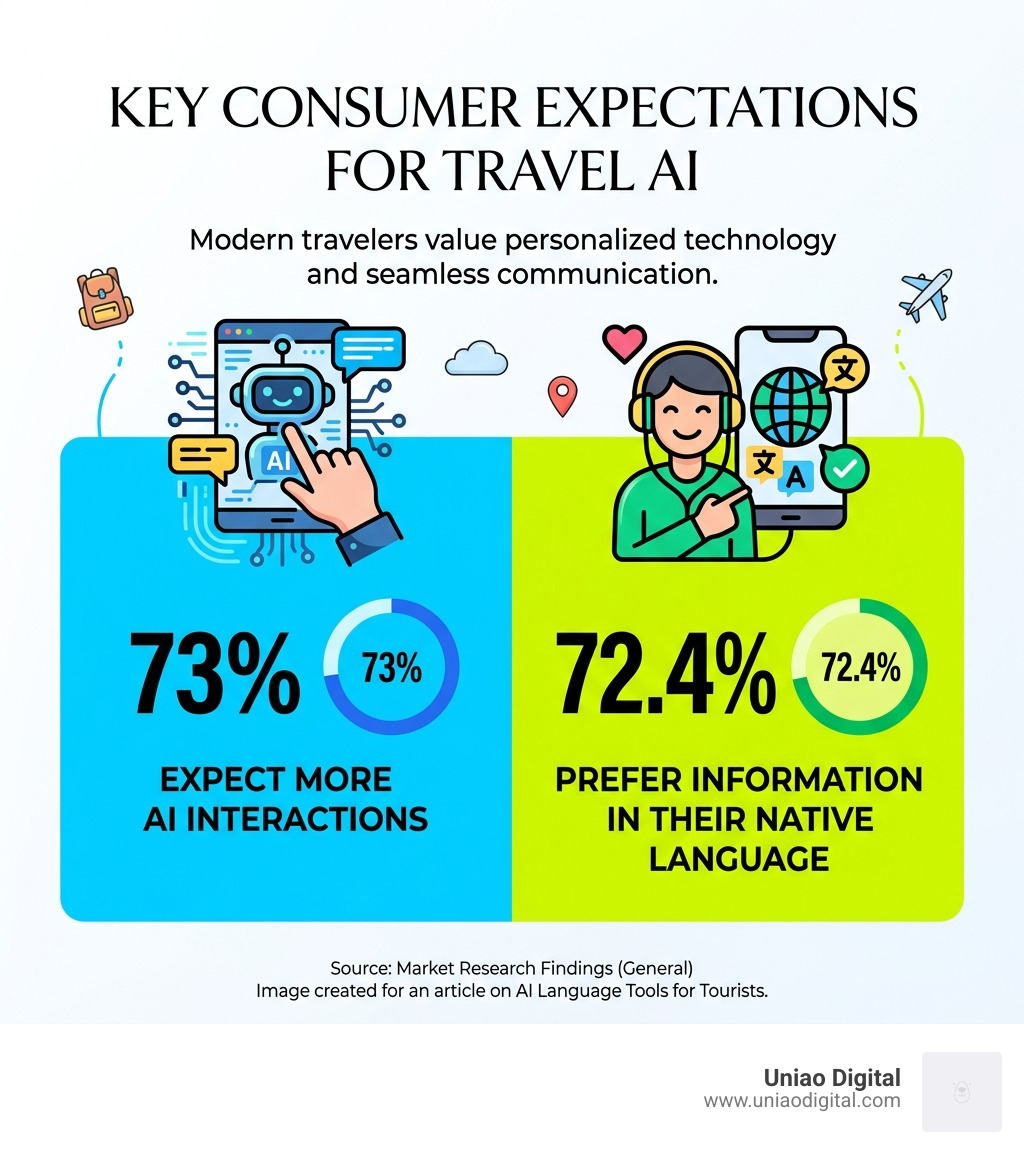
- Native Language Preference: Research shows that 72.4% of people prefer to buy or interact when information is in their native language. Having a tool that speaks “your” language makes you a more confident traveler.
- Time Savings: Companies using AI translation report reclaiming about 175 hours per employee annually. For you, the tourist, this means less time staring at a map in confusion and more time enjoying the sights.

Cost Comparison: AI vs. Human Translation for Travel
| Feature | AI Translation | Human Translation |
|---|---|---|
| Price | $10–$25 per million characters | $0.15–$0.30 per word |
| Speed | Under 2 seconds | Hours to days |
| Availability | 24/7 on your smartphone | Business hours / Appointment |
| Accuracy | 80–90% (Common pairs) | 99–100% |
| Best For | On-the-go needs, menus, directions | Legal documents, complex contracts |
Choosing the Best AI Language Tool for Tourists
With so many options available in April 2026, how do you pick the right one? The “best” tool isn’t necessarily the one with the most languages; it’s the one that fits your specific travel style.
The AI in tourism market is projected to reach nearly $14 billion by 2030, which means the market is currently flooded with apps. To cut through the noise, look at the User Experience (UX). Is the app easy to open and use with one hand while you’re carrying luggage? Does it respect your data privacy, or is it selling your location history? Compatibility is also key—make sure the app works seamlessly with your specific device and smartwatch.
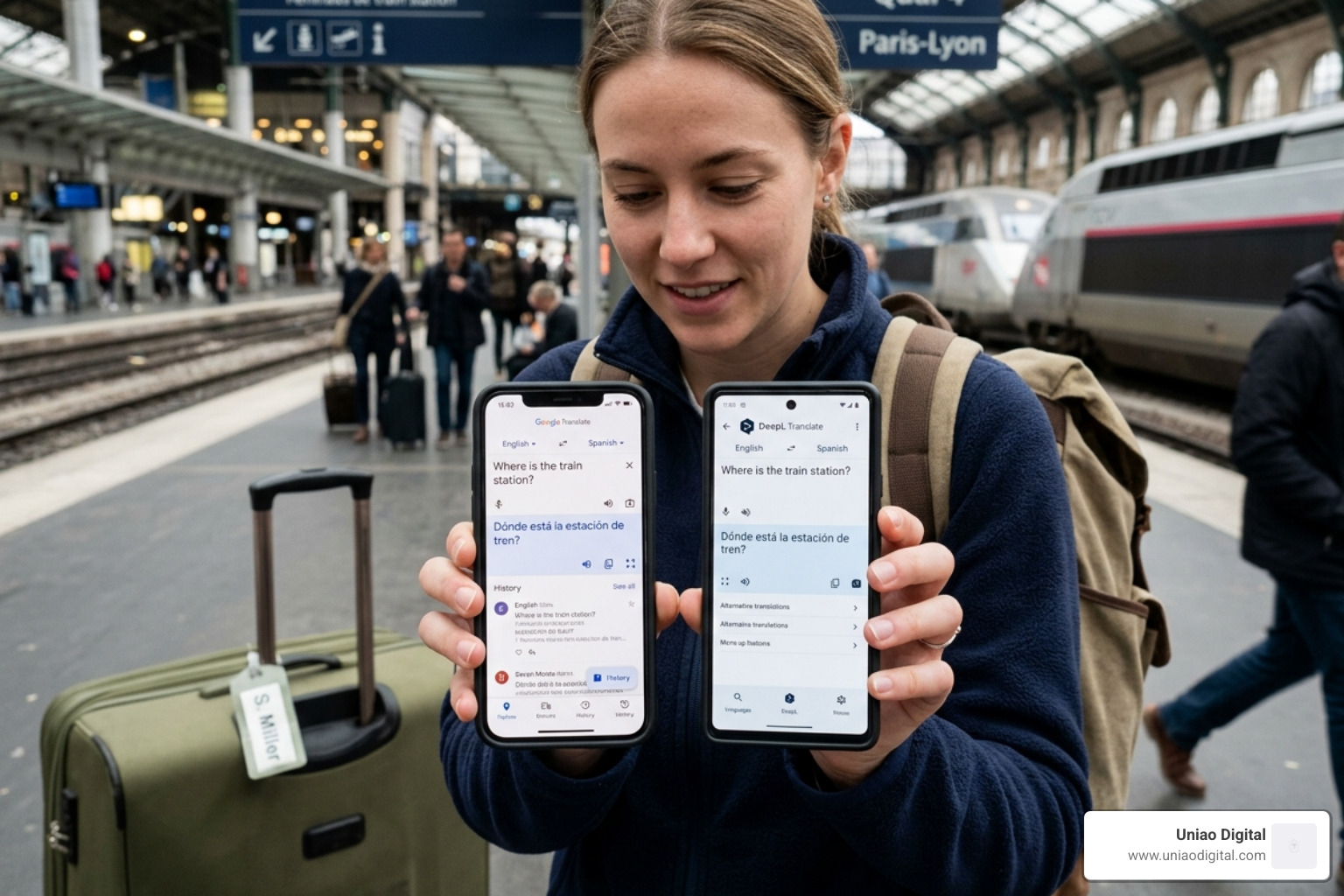
Essential Features of an AI Language Tool for Tourists
When we evaluate tools at Uniao Digital, we look for these “must-have” features:
- Offline Access: This is non-negotiable. You can’t always rely on international data or spotty hotel Wi-Fi.
- Voice Input & Phonetic Transcription: If you’re trying to learn a phrase, seeing the phonetic spelling (e.g., “Konnichiwa” for こんにちは) is incredibly helpful.
- Cultural Etiquette Tips: Some advanced tools now provide “etiquette alerts”—for example, reminding you to take your shoes off before entering a home in certain countries.
- Currency & Unit Conversion: It’s helpful if your translator can also tell you that 500 Thai Baht is about 14 US Dollars.
- Emergency SOS Features: The ability to instantly translate “I need a doctor” or “I am lost” into the local tongue and broadcast your GPS location can be a literal lifesaver.
Why Every Traveler Needs an AI Language Tool for Tourists
It’s not just about convenience; it’s about safety and authentic connection.
When you can speak the local language—even through an app—you are less likely to be targeted by “tourist traps” or overcharged. You can manage your budget better by asking for prices in the local tongue. Most importantly, it reduces the “travel stress” that comes from the unknown.
With 73% of customers now expecting AI to improve their daily lives, and businesses seeing a 1.5x increase in revenue when they invest in translation, the world is moving toward a multilingual future. Using an ai language tool for tourists ensures you aren’t left behind.
The Future of AI in Global Tourism
Looking ahead, the next few years will bring even more “sci-fi” features to our trips.
- AR (Augmented Reality) Integration: Imagine wearing a pair of lightweight glasses that translate street signs and museum labels in real-time as you look at them. No phone required.
- Satellite Connectivity: New smartphones are already connecting to satellites, meaning you could use your AI translator in the middle of the Sahara Desert or the Amazon rainforest.
- Autonomous Assistants: We are moving toward “Travel Agents in your pocket” that don’t just translate, but proactively warn you about weather changes or suggest a nearby cafe based on your past preferences.
- Personalized Discovery: AI will help you find “hidden gems” that aren’t in the major guidebooks, translating local blogs and social media posts to give you a truly “off-the-beaten-path” experience.

Frequently Asked Questions about AI Language Tools
How do AI tools handle cultural nuances for tourists?
Modern AI uses “context windows” to look at the words surrounding a phrase. Instead of a literal translation, the AI identifies the intent. For example, it can distinguish between “booking a room” (hospitality) and “booking a criminal” (law enforcement). At Uniao Digital, we specifically train our models on travel-specific data to ensure the tone is always polite and culturally appropriate.
Are AI language tools accurate enough for medical emergencies?
For common symptoms (fever, broken bone, allergy), AI tools are highly accurate (90%+). However, for complex medical diagnoses, they should be used as a bridge to get immediate help. Many tools now include a “Medical Mode” that uses verified terminology to ensure your symptoms are communicated clearly to healthcare providers.
Can I use an AI language tool without an internet connection?
Yes! Most major apps, including our own Uniao Digital tools, allow you to download “Language Packs.” While the offline versions might be slightly less “smart” than the cloud-based ones, they are more than sufficient for 95% of tourist interactions like ordering food or asking for the bathroom.
Conclusion
Travel is about breaking down walls, and language has traditionally been the thickest wall of all. But in 2026, that wall is crumbling. Whether you’re a solo adventurer or a family on their first international trip, an ai language tool for tourists is your ticket to a deeper, safer, and more colorful experience.
At Uniao Digital, we believe that everyone should be “travel-ready.” By focusing on local slang and travel communication, we help you move past the “tourist” label and start connecting with people as a guest. We want you to feel the thrill of a successful conversation in a language you didn’t know yesterday.
Ready to explore the world without limits? Discover our AI-powered solutions today and see how we can help you navigate your next adventure. For more information on our mission, visit our Sobre Nosotros page. Happy travels!
