
Mastering the Basics with Duolingo for Travel
Is Duolingo Worth It for Travel? Here’s the Quick Answer
Duolingo for travel is genuinely useful – but only if you go in with the right expectations.
Here’s a fast breakdown for travelers evaluating it right now:
| Your Situation | Is Duolingo Enough? |
|---|---|
| 2 weeks before a trip, zero experience | Partially – great for basic phrases, not for conversations |
| 1-3 months of consistent daily use | Yes – solid foundation for restaurants, hotels, directions |
| Want to chat naturally with locals | No – you’ll need to supplement with other tools |
| Need offline phrase access while traveling | Yes (paid plan required for full offline access) |
| Total beginner wanting a free starting point | Absolutely yes |
The short answer: language-learning apps like this can build real vocabulary and habits, but they won’t fully prepare you for fast local speech, slang, or dialects.
Mobile language learning has become a major part of trip preparation, especially among younger travelers who want more than a phrasebook-level experience. Many travelers now use daily practice apps before short international getaways so they can navigate simple interactions with more confidence.
That’s not a casual relationship with language learning. That’s a habit.
But here’s the tension every traveler hits: app-based language study is built for the long game. Gamified lessons are excellent for forming daily habits and picking up vocabulary. What they are less good at is getting you ready to understand a fast-talking waiter in Naples or decode regional slang in a Lisbon market – the exact situations frequent international travelers face most.
This article breaks down exactly what this kind of app-based learning can and can’t do for travel prep, where the travel-specific content lives inside the app, how it compares with dedicated travel-focused tools, and how to get the most out of it before your next trip.
Is Duolingo for Travel Effective for Your Next Trip?
When we look at whether duolingo for travel actually works, we have to define what “working” means for a traveler. In April 2026, the app remains one of the world’s most widely used ways to learn because it is free, fun, and research-backed. It uses a combination of AI and language science to create personalized lessons that adapt to your pace.
For a traveler, Duolingo is highly effective at building recognition. Research on app-based language learning shows that bite-sized lessons are excellent for teaching you how to read signs, decode menus, and understand basic instructions. The motivation is often deeply personal, with many younger learners using language apps specifically to connect with local cultures when traveling. They don’t just want to see the sights; they want to practice languages in real life.
However, the app’s effectiveness is often tied to its gamification. The streaks and leaderboards keep you coming back, which is vital for long-term retention. If your goal is to show respect to your hosts by greeting them in their native tongue, Duolingo is a home run. If your goal is to negotiate a complex lease for a three-month stay, you might find the game-like features a bit too simple for the high stakes involved.
Realistic Skill Levels for Travelers
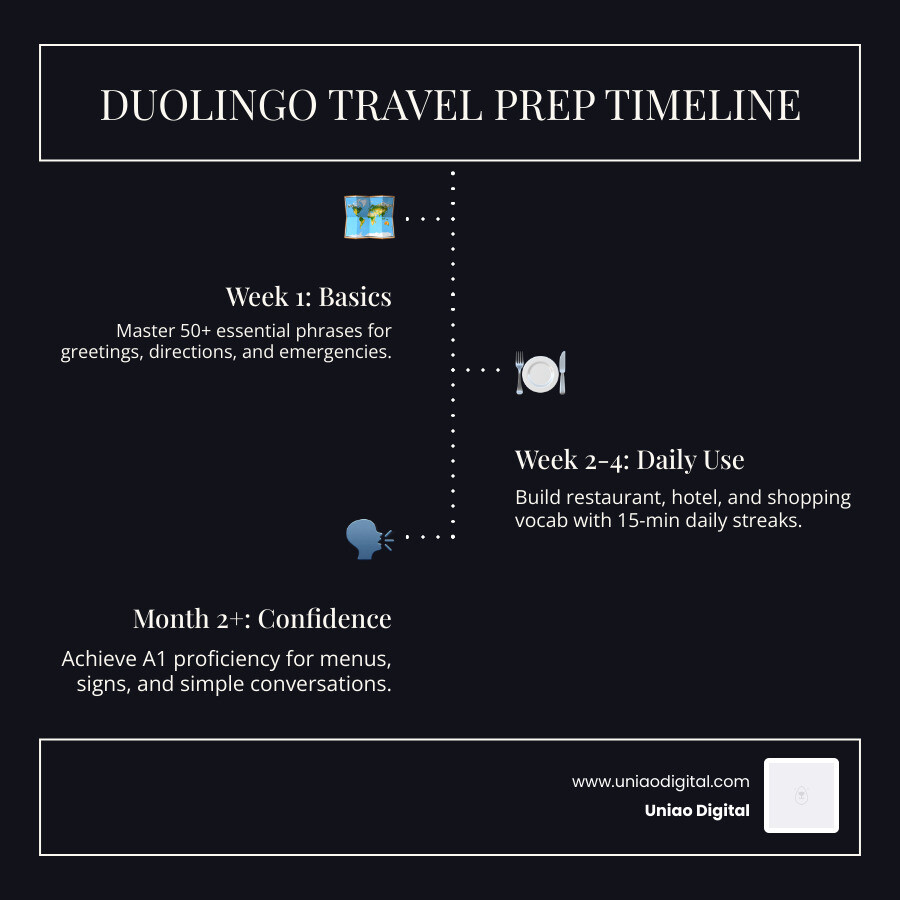
What can you actually do after using the app? Most travelers will reach what is known as A1 proficiency. This is the “tourist level” of communication. It’s perfect for transactional conversations-those predictable, script-based interactions like checking into a hotel or buying a train ticket.
You will likely achieve high levels of menu recognition and basic reading skills. However, listening comprehension often lags behind because the app’s audio is clear and digitized, whereas real-world speech is fast, messy, and full of background noise.
| Learning Duration | Expected Outcome | Real-World Capability |
|---|---|---|
| 2 Weeks | Basic Greetings & Numbers | Can say “hello,” “please,” and order one coffee. |
| 1 Month | Essential Questions | Can ask “Where is the bathroom?” or “How much?” |
| 3 Months | Transactional Fluency | Can handle a full hotel check-in and order a multi-course meal. |
| 6 Months+ | Basic Conversation | Can share simple facts about yourself and understand slow replies. |
Timelines: 2 Weeks vs. 6 Months of Duolingo for Travel
Timing is everything. If you have six months before your trip, Duolingo is your best friend. The streak system will help you build a massive vocabulary and a solid grasp of basic grammar. You’ll have time to move through the bubbles multiple times, which is essential for moving words from short-term to long-term memory.
If you only have two weeks, your strategy must change. You won’t have time to unlock the deeper levels naturally. In this case, Duolingo serves as a warm-up tool to get your brain used to the sounds of the language. You’ll want to focus on the most immediate units rather than trying to master the entire tree. For short European getaways, even a few days of practice can make many travelers feel bolder in their travel choices, helping them venture away from tourist hotspots and into more authentic areas.
Navigating Travel-Specific Lessons and Features
One common frustration is that travel-specific phrases aren’t always front and center. The curriculum is designed to build a foundation first. This means you might spend your first three days learning how to say “The boy eats an apple” before you learn how to ask for the bill.
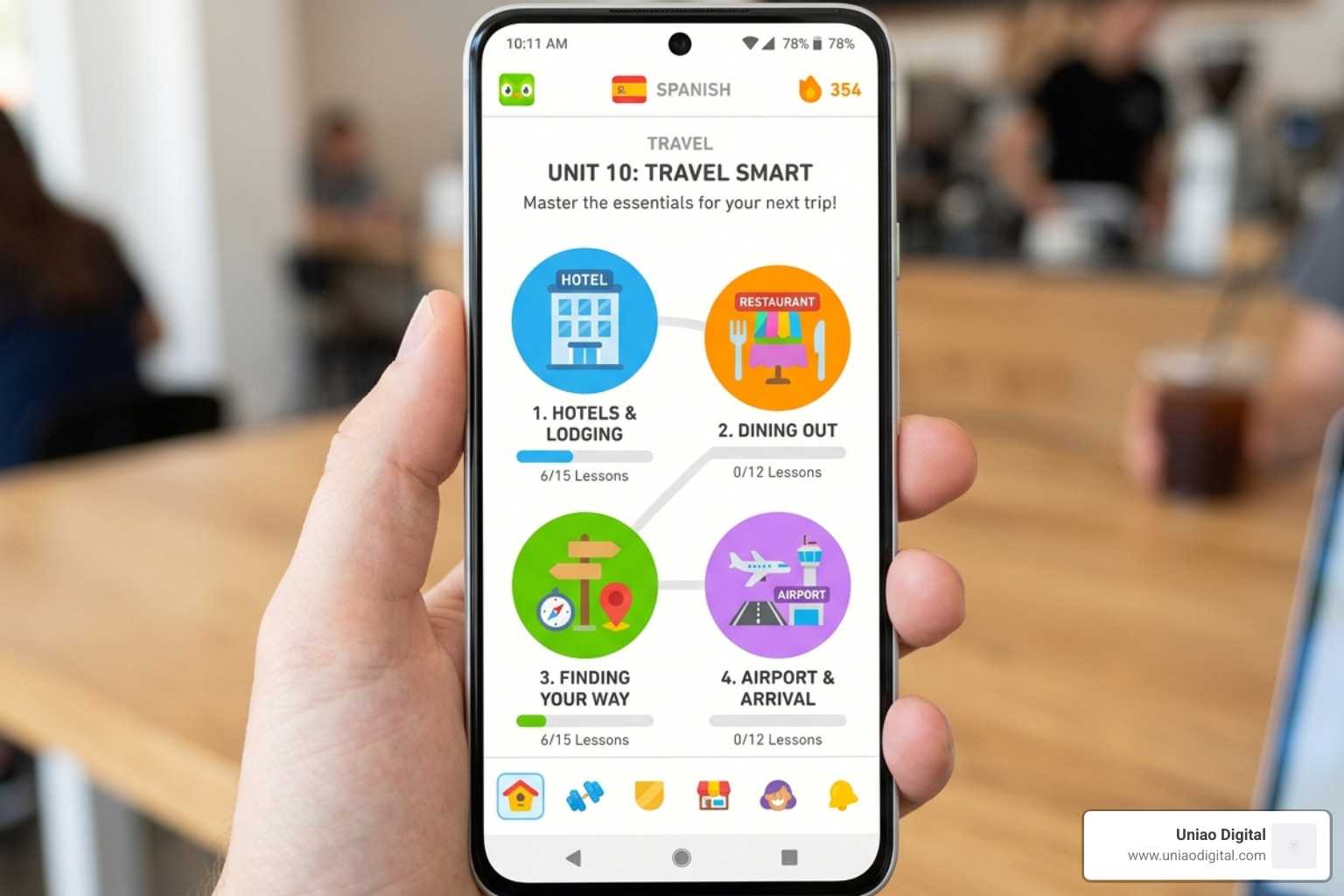
To find the travel content, you need to look at the “Unit” descriptions. Most courses have dedicated units for “Travel,” “Restaurant,” and “City.” These are usually located in the first two sections of the path. The app uses smart learning algorithms to prioritize vocabulary that appears frequently in real life, but it doesn’t always allow you to jump straight to a travel-only mode without testing out of previous levels.

Maximizing Speaking and Pronunciation Practice
Speaking is the hardest part of travel. The app uses voice recognition to check your pronunciation, but it’s often quite forgiving. To truly prepare, we recommend these home practice tips:
- Repeat Aloud: Don’t just tap the screen; say every sentence out loud, even the ones that don’t require a speaking exercise.
- Listen to Native Audio: Use the “Stories” feature if available in your target language. These provide more natural dialogue and rhythm than the standard exercises.
- Talk to Your Pets: As the research suggests, talk to your cat or your friends – they don’t even have to be listening! The goal is to get your mouth used to making new shapes.
Free vs. Paid Versions for Quick Prep
Is the paid plan worth it for a trip? For most travelers, the answer depends on your internet access. The premium version offers:
- Offline Accessibility: This is crucial if you are traveling to rural areas or don’t want to rely on expensive roaming data.
- No Ads: When you’re in a hurry to squeeze in a lesson at the airport, ads are a major distraction.
- Personalized Practice: The paid version tracks your “Mistakes” and creates custom lessons to fix them.
If you want to dive deeper into how technology is changing the way we move across borders, you can find More info about language tools on our main site.
Strengths and Weaknesses of Using Duolingo for Travel
Duolingo’s biggest strength is its global reach and engagement. It supports over 100 languages, including niche ones like Scottish Gaelic or Esperanto. The gamification makes it feel less like “studying” and more like a hobby.
However, the weaknesses are real. The app often lacks deep grammar explanations, which can leave you confused about why a sentence is structured a certain way. Furthermore, it doesn’t teach you how to “ad-lib.” If a local asks you a question that isn’t in the Duolingo script, you might find yourself “stymied” by the speed and rhythm of natural speech.
Overcoming the Limitations of Duolingo for Travel
To truly be “travel-ready,” you need to supplement the app. Duolingo is excellent for the “what,” but it sometimes struggles with the “how.” It won’t teach you that a shopkeeper waving their arms in an ‘X’ shape means “we are closed,” or that “embarazada” in Spanish means pregnant, not embarrassed!
We suggest using the “fill-in-the-blank” method. Even if you only understand 10% of what someone says, use context clues like body language and location-based logic to guess the rest. If you’re at a train station and an announcement plays, it’s probably about a delay or a platform change—use that logic to narrow down the words you’re hearing.
Customizing Your Learning Path
You don’t have to follow the path blindly. If you are preparing for a trip, you can:
- Skip Levels: If you already know the basics, use the “Test Out” feature to move to more advanced travel units.
- Focus on Food: If you have allergies, prioritize the units that cover ingredients.
- Emergency Phrases: Make a manual note of phrases for “Help,” “Doctor,” or “I am lost,” as these are often buried deep in the curriculum.
Frequently Asked Questions about Travel Language Learning
Does the app work offline for travelers?
Yes, but primarily for Super Duolingo (paid) subscribers. While the free version allows some caching of lessons, the most reliable way to practice on a plane or in a remote mountain village is to have a premium subscription that allows for full lesson downloads.
Where are the travel-specific phrases located in the app?
They are integrated into the “Path.” Look for Unit headers labeled “Travel,” “Order Food,” or “Getting Around.” You can also find useful dialogue practice in the “Stories” tab (represented by a book icon) in many major languages like Spanish, French, and German.
Can I become fluent enough for a trip in just one month?
Fluency is a high bar that takes years. However, in one month of duolingo for travel use, you can absolutely become “transactionally competent.” You will be able to handle the basic logistics of your trip, which often makes the difference between a stressful vacation and an immersive cultural experience.
Conclusion
At Uniao Digital, we believe that technology should bridge the gap between “learning” and “connecting.” While Duolingo is a fantastic foundation for building a daily habit and learning essential vocabulary, real-world travel often requires a bit more nuance. Our focus on AI-powered slang tools and travel tech innovation is designed to help you handle the colloquialisms and regional accents that standard apps might miss.
Duolingo is the perfect “warm-up.” It makes you bolder, helps you respect local cultures, and ensures you won’t be totally lost when looking at a menu in a rural Italian village. But remember: the goal isn’t to be perfect. It’s to be understood. Whether you’re stumbling through a greeting with the “grace of a newborn gazelle” or successfully ordering your first local beer, the effort is what counts.
Start your journey today and see how our tools can supplement your learning for a truly local experience. Happy travels!
