
From ‘Ouf’ to ‘Fou’: Mastering Local Slang with Pocket AI
Why Local Slang AI Pocket Tools Are Changing How We Communicate Abroad
Local slang AI pocket apps let you understand and use real, everyday language — not just textbook translations — directly from your phone, even without an internet connection.
Here’s a quick overview of the top features and what they do:
| Tool Category | Best For | Key Feature | Works Offline? |
|---|---|---|---|
| Dialect Translators | Slang & regionalisms | Rizz Mode, emoji translation | Yes |
| Private AI Assistants | Secure on-device chat | GGUF model support | Yes |
| Lightweight LLMs | Fast offline chat | No account required | Yes |
| Multilingual Tools | Private global travel | 23+ languages supported | Yes |
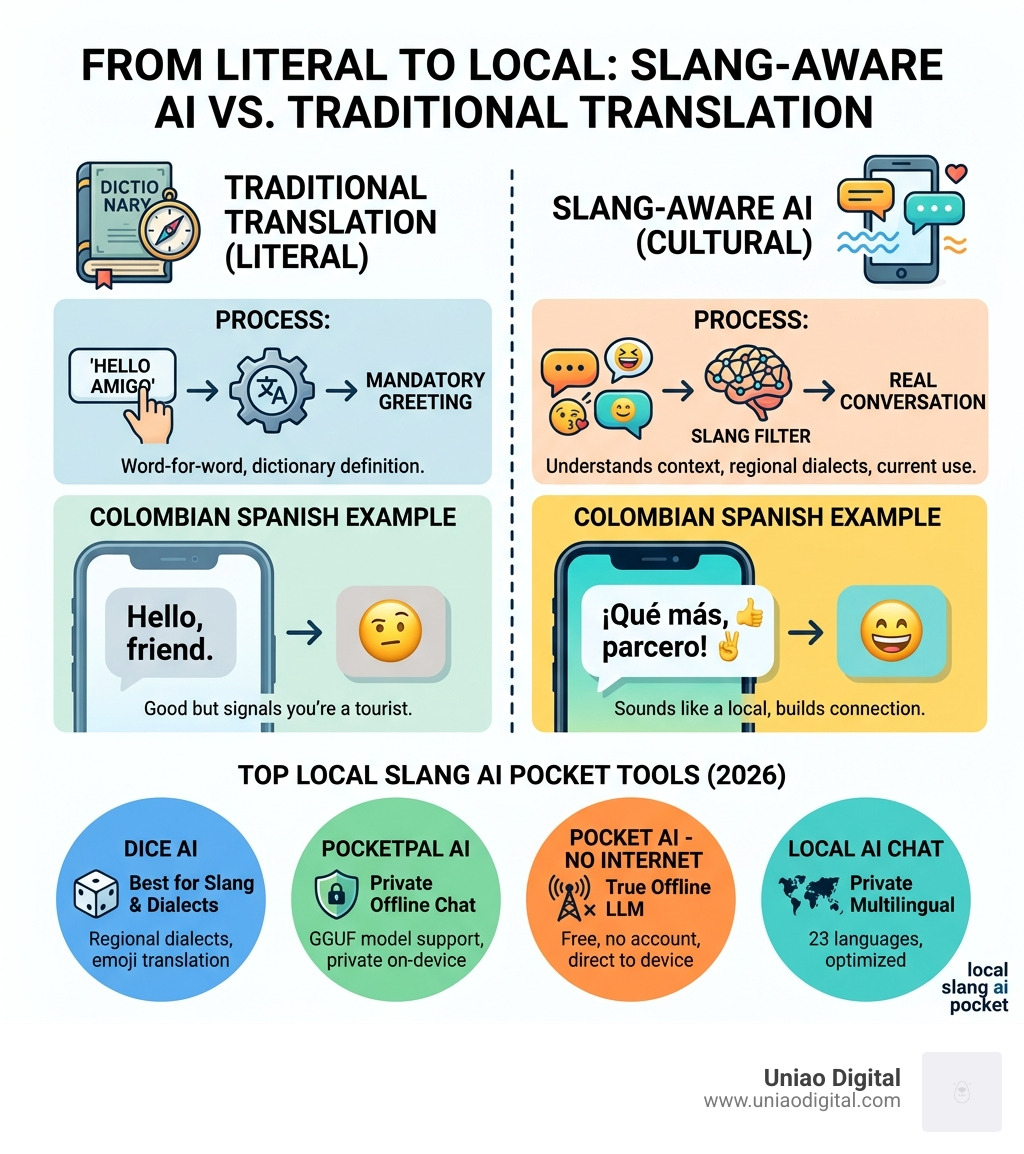
You land in Medellín and greet someone with “amigo.” They smile politely. But the locals say parcero. That one word signals the difference between a tourist and someone who actually gets the culture.
This gap — between literal translation and real communication — is exactly what the latest generation of natural language processing tools is built to close.
Traditional translation apps give you the dictionary version of a language. But language is alive. It shifts by region, generation, and context. Colombian Spanish is not Mexican Spanish. French slang in Paris sounds nothing like what you’re hear in Montreal.
AI is finally catching up to the way people actually talk.
Whether you need a pocket-sized AI that runs fully offline for privacy, or a slang-aware translator that decodes memes and WhatsApp voice notes, there are now real tools built for this exact problem.
This guide breaks down the best local slang AI pocket options available in 2026 — what they do, who they’re for, and how to choose the right one for your next trip.
The Evolution of Local Slang AI Pocket Technology
We have come a long way from the days of fumbling through paper phrasebooks. In April 2026, the landscape of language technology has shifted from simple word-swapping to deep neural understanding. The rise of local slang ai pocket technology is driven by massive investments in conversational intelligence, with companies in the hospitality and travel sectors leading the charge.
For instance, the business side of this technology has seen explosive growth. Leading developers in the space recently secured a $36M Series B funding round, bringing their total capital to $68M. Why is so much money flowing into this space? Because communication is a billion-dollar problem. In the restaurant industry alone, nearly half of all phone calls go unanswered daily, resulting in staggering revenue loss.

Current AI “Superhosts” are now handling over 25 million calls across 2,000+ restaurant locations. These systems don’t just answer the phone; they manage reservations and inquiries with a 95%+ guest satisfaction rate. This same high-level processing power is now being miniaturized into the local slang ai pocket apps we use as travelers. We are seeing a transition where the “brain” of a multi-million dollar customer service bot is effectively being tucked into our pockets to help us navigate a Parisian bistro or a Tokyo night market.
Understanding Context with Local Slang AI Pocket Tools
The secret sauce of modern AI isn’t just knowing more words; it’s understanding context. Traditional translators often fail because they lack cultural awareness. A local slang ai pocket tool, for example, is specifically designed as a translator that “actually gets slang.”
These tools utilize context-aware AI to interpret tone, emotion, and nuance. They understand that Colombian Spanish is fundamentally different from Mexican Spanish. They can even translate culturally correct emojis—because we all know that a specific emoji might mean something completely different in London than it does in Dubai. By offering gender-aware translations and tone controls, these apps ensure you don’t just say the right words, but you say them with the right “vibe.”
Mastering Dialects: How AI Decodes Regional Nuances
When we talk about mastering a language, we’re really talking about mastering its dialects. A local slang ai pocket assistant acts as a bridge between the formal language you learned in school and the “real” language spoken on the street.
Take the word “parcero” mentioned earlier. A standard translator might just say “friend.” But a specialized AI understands the weight of that word in Medellin. These apps are now capable of:
- Meme Culture Translation: Decoding the latest internet humor so you aren’t left out of the loop.
- WhatsApp Audio Translation: You can forward voice notes directly to the app to get a natural translation in seconds.
- Photo Analysis: Upload a photo of a social setting, and the AI can suggest “icebreakers” or compliments tailored to the scene.

One of the most innovative features we’ve seen recently is “Rizz Mode.” While it sounds playful, it’s actually a sophisticated application of emotion modeling. It helps users craft messages with different levels of “vibe”—from “Suave” for smooth sophistication to “Spicy” for more energetic interactions. It’s about more than just being understood; it’s about being charming.
Choosing Your Local Slang AI Pocket Assistant
With so many options, how do you choose? We look for tools that balance power with privacy.
- Community-Driven Apps are standouts for the DIY and privacy-focused crowd. With over 1.2 million downloads and high user ratings, these are community-driven powerhouses. Many have thousands of stars on GitHub and are supported by contributors ensuring they stay at the cutting edge of open-source models.
- Multilingual Pocket Tools offer support for English plus dozens of other languages. They are a great middle-ground for those who want a polished experience that remains fully private.
- Slang-Aware Assistants are the go-to for those who prioritize the latest slang and social features, boasting high ratings from users who love their “Rizz” and dialect capabilities.
Privacy and Performance: Why Local Apps Run Offline
In 2026, the biggest trend in local slang ai pocket tech is “on-device inference.” This means the AI “thinks” entirely on your phone’s processor rather than sending your data to a distant server.
Why does this matter?
- 100% Privacy: Your conversations never leave your device. There are no accounts, no logins, and zero data collection.
- Zero Latency: You don’t have to wait for a signal to bounce to a server and back.
- Offline Functionality: It works in airplane mode, in underground subways, or in remote hiking trails where there’s no cell service.
Modern apps are optimized for Apple Silicon and utilize the Metal GPU to run Large Language Models (LLMs) locally. For example, optimized offline AI apps can achieve up to 45 tokens per second on an iPhone 12 or newer. This is fast enough for a fluid, real-time conversation.
Technical Requirements for Local Slang AI Pocket Apps
To run these powerful models, you do need a relatively modern device. Most local slang ai pocket apps require an iPhone 12 or newer. This is because local AI is hardware-intensive.
Here is a breakdown of what you can expect in terms of storage and performance:
| Model Size | Recommended Device | Speed (Approx.) | Storage Required |
|---|---|---|---|
| Qwen 0.6B | iPhone 12/13 | 45 tokens/sec | ~460 MB |
| Qwen 1.7B | iPhone 14/15 | 30 tokens/sec | ~1.1 GB |
| Qwen 4B | iPhone 15 Pro/16+ | 14 tokens/sec | ~2.7 GB |
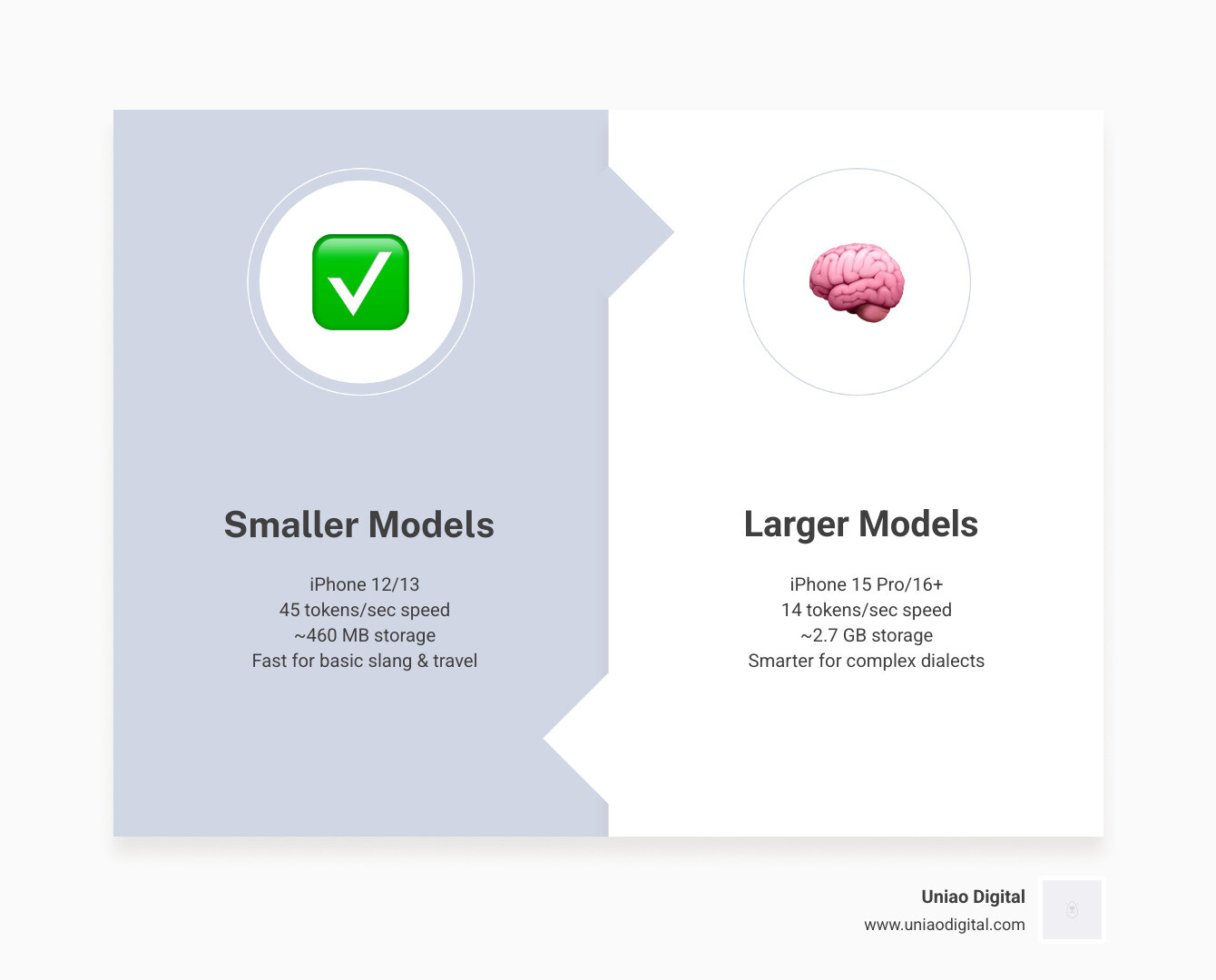
These models use what’s called Q4KM quantization—a technical way of saying they’ve been “shrunk” to fit on a phone without losing their intelligence. While the 4B (4 billion parameter) models are the smartest, even the tiny 0.6B models are incredibly capable for basic slang and travel phrases.
Business vs. Personal Use Cases
It’s important to distinguish between the high-end enterprise tools and the consumer local slang ai pocket apps we use for travel.
Business Solutions: These are designed for high-volume environments. A restaurant might pay a monthly fee for a system that handles 500+ calls, integrates with CRM platforms, and recovers missed leads. For a busy operator, the ROI can be as high as 20x. These systems are “Superhosts”—they sound human, handle complex booking logic, and never get tired.
Personal Pocket Apps: These are built for us—the travelers. The pricing is much more accessible, often ranging from a few dollars a week to a yearly subscription. Some are even entirely free. These apps focus on personal interaction: helping you order street food, decode a local meme, or flirt with a local (responsibly, of course!).
While a business tool focuses on “call resolution” and “revenue optimization,” our local slang ai pocket tools focus on “cultural immersion” and “meaningful connection.”
Frequently Asked Questions
How do local AI pocket apps ensure privacy?
Most of these apps are “Private by Design.” Because they use on-device inference, your data literally has nowhere to go. Leading offline AI tools don’t require accounts or logins. They don’t use background network calls or analytics SDKs. Your chat history is stored in your phone’s private storage, and the developers have no way to read it. Open-source apps take this a step further by allowing the community to audit the code to ensure no “backdoors” exist.
Can I use local slang AI without an internet connection?
Yes, absolutely. That is the primary “selling point” of the local slang ai pocket category. Once you download the initial model (which can range from 460MB to 2.7GB) over Wi-Fi, the app never needs the internet again. It will work perfectly in airplane mode, in a rural village, or in a concrete basement. This is a game-changer for travelers who don’t want to rely on expensive roaming data or spotty public Wi-Fi.
What is the difference between enterprise AI solutions and personal pocket AI?
The main difference is scale and integration. Enterprise solutions (B2B) are built to handle thousands of calls, integrate with professional CRM systems, and provide detailed analytics dashboards for business owners. They are “voice-first” and designed for the phone lines. Personal pocket AI (B2C) is “user-first.” It’s designed for text and image interaction, focuses on a wide variety of LLMs (like Llama, Mistral, or Gemma), and prioritizes features like personalized AI personalities and slang translation for social settings.
Conclusion
At Uniao Digital, we believe that the best part of traveling isn’t just seeing new places—it’s connecting with the people who live there. The rise of local slang ai pocket technology is a massive leap forward for travel tech innovation. We are moving past the era of being “lost in translation” and into an era of deep cultural immersion.
By utilizing on-device LLMs, we can now carry a sophisticated linguistic expert in our pockets that respects our privacy and works anywhere on the planet. Whether you’re using a community-supported tool or a slang-heavy assistant, you’re no longer just a tourist with a dictionary. You’re a traveler with the keys to the local culture.
The future of travel is local, it’s private, and it’s powered by AI that finally understands the difference between “amigo” and “parcero.”
