
How to Win at Chinese Market Bargaining
Why Chinese Market Bargaining Tips Can Save You Serious Money
Chinese market bargaining tips are essential knowledge for any traveler heading to China’s famous street markets and bazaars. Without them, you could easily pay 2 to 3 times more than a local for the exact same item.
Here are the core tips to get started right away:
- Start low – Offer 25-30% of the asking price to leave room to negotiate up
- Act uninterested – Never show excitement about an item you want
- Use key phrases – “太贵了!” (Tài guì le! = “Too expensive!”) goes a long way
- Walk away – About 70% of the time, the vendor will call you back with a lower price
- Use a calculator – Type numbers back and forth to skip the language barrier
- Carry small bills – Large notes signal wealth and weaken your position
- Shop late in the day – Vendors are more willing to drop prices near closing time
- Know where to haggle – Markets and souvenir stalls yes; Starbucks and chain stores, no
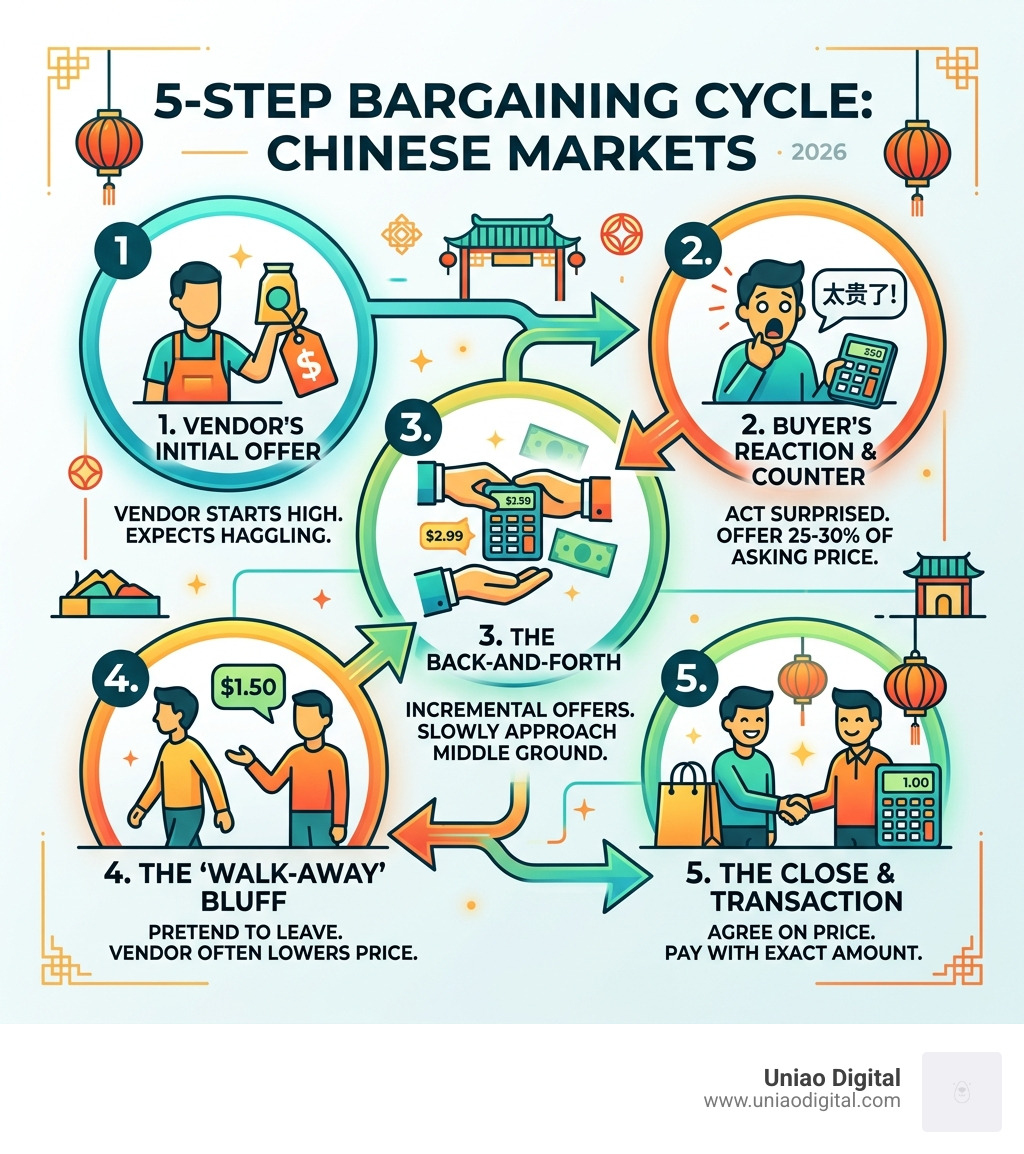
Think of bargaining in China as a performance. Both the buyer and seller know their lines. The vendor opens high. You react with mild shock. You counter low. You inch toward the middle. Someone walks away. Someone calls them back.
It sounds dramatic — because it is. But that’s the point.
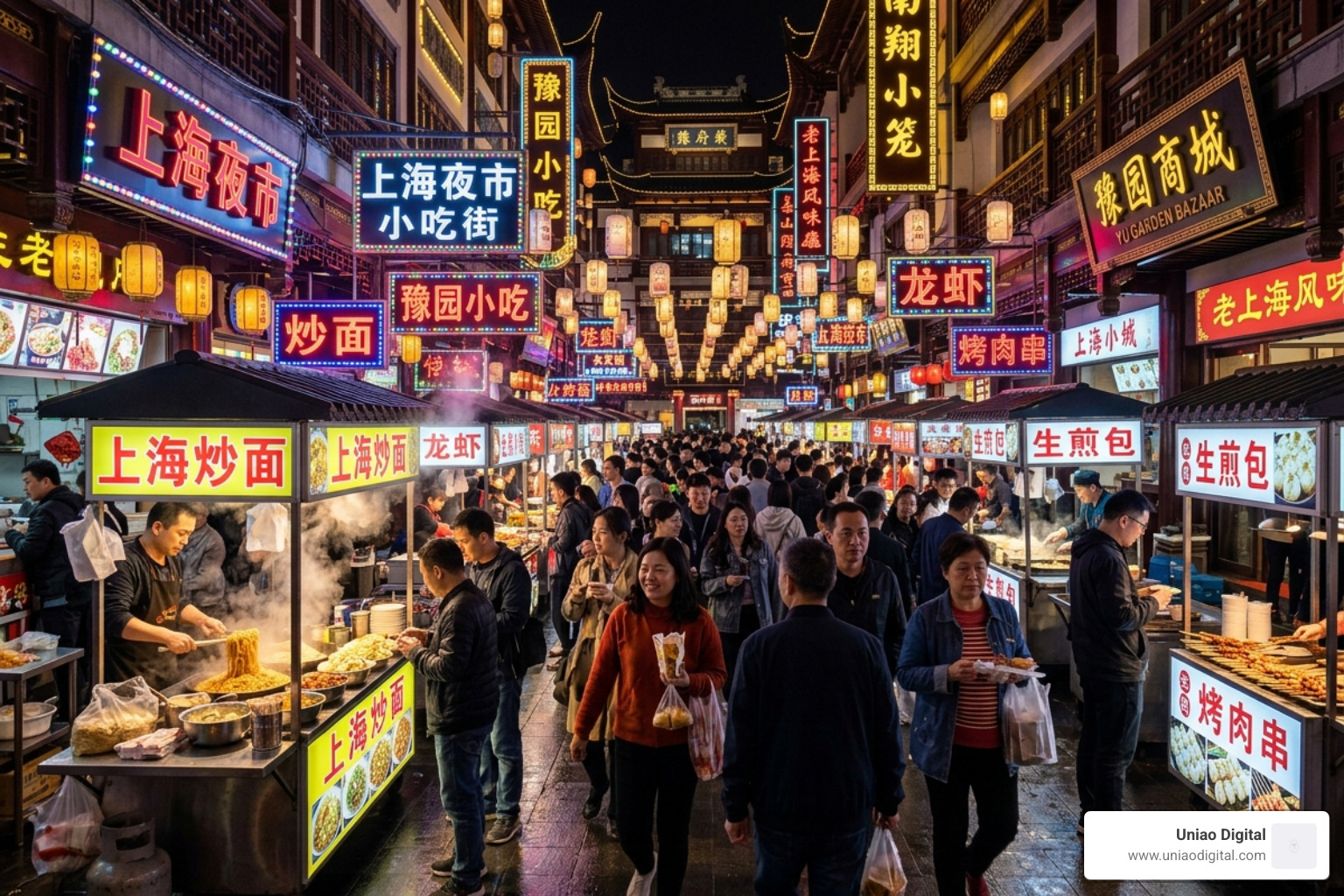
In tourist markets like Beijing’s Silk Market or Shanghai’s Yuyuan Bazaar, vendors expect you to haggle. Paying the first price they quote doesn’t make you generous — it just means you overpaid. Sellers will never go below what they can profit from, so there’s no need to feel guilty about pushing for a better deal.
The good news? You don’t need to be fluent in Mandarin or have years of experience. A few smart strategies and a handful of key phrases are enough to completely change your shopping experience.
Understanding the Art of Chinese Market Bargaining Tips
When we step into a bustling market in Beijing or Shanghai in 2026, we aren’t just entering a place of commerce; we are stepping onto a stage. Bargaining in China is a deeply rooted cultural ritual. It is a “ritualized dance” where both parties play a role to find a price that satisfies everyone.
One of the most important concepts to understand is “Face” (Mianzi). In Chinese culture, “giving face” means showing respect. A successful negotiation isn’t about crushing the vendor until they make zero profit—it’s about a win-win outcome where both parties feel they’ve made a good deal. If you are too aggressive or rude, the vendor might refuse to sell to you just to save their dignity, even if your price is fair.
Why bargaining is a cultural expectation
For many Chinese vendors, haggling is a form of social interaction and relationship building. It’s a way to build trust. In ancient China, there were no unified pricing standards, so prices were always flexible based on the buyer’s needs and the seller’s stock.
Today, this tradition continues in street markets. Vendors often set an initial “foreigner price” that is 2x to 3x (or even 10x in extreme tourist traps) what a local would pay. By using our chinese market bargaining tips, you aren’t being “cheap”—you are simply participating in the local economy as it was intended.
Identifying the right venues for Chinese market bargaining tips
Not every store in China is a negotiation zone. If you try to haggle for a latte at Starbucks or a bag at a high-end mall like SKP Beijing, you’ll likely receive a confused stare.
We recommend focusing your bargaining energy on:
- Street Markets: Open-air stalls selling everything from socks to snacks.
- Specialty Markets: Places like the Silk Market in Beijing or the Yatai Xinyang Market in Shanghai.
- Flea Markets: The famous Panjiayuan Flea Market is perfect for antiques and curios.
- Small Souvenir Shops: Especially those near major tourist attractions like the Great Wall or the Terracotta Warriors.
For a quick reference, check out these 10 Tips for Bargaining in Beijing to see how the pros handle the capital’s specific market scene.
| Venue Type | Bargaining Status | Strategy |
|---|---|---|
| Department Stores | Fixed Price | No haggling; look for official sales. |
| Street Markets | Highly Negotiable | Start at 25-30% of asking price. |
| Supermarkets | Fixed Price | Prices are set at the register. |
| Souvenir Stalls | Negotiable | Use the “walk away” technique. |
| High-end Malls | Fixed Price | Generally no bargaining unless buying bulk luxury. |
Strategic Preparation: When and Where to Shop
Timing is everything. If you want the best deals, we suggest shopping during low-traffic periods. Mid-week mornings are great, but the absolute best time is late in the day, just before the market closes. Vendors are often eager to make one last sale to boost their daily total and are more likely to agree to a lower price just to clear stock.
Knowing when to avoid the haggle
As of April 2026, the lines between fixed-price and negotiable stores are clearer than ever. Always avoid haggling in:
- International Chains: Apple, Nike, Starbucks, etc.
- Convenience Stores: 7-Eleven or FamilyMart.
- Public Transport: Ticket offices for trains or buses.
- Restaurants: Unless you are a very large group in a private room, the menu price is the final price.
Researching market value before you go
Before you head out, do a quick “sanity check” on prices. If a silk scarf costs $30 at home, you can likely get it for $7 to $15 in China if you bargain well. Use online platforms like Taobao or JD.com to see what the “real” local price is for common items. This prevents you from being “anchored” by a vendor’s ridiculously high opening quote.
When you arrive at a market, don’t buy from the first stall you see. Walk around, ask for prices at 2 or 3 different spots, and get a feel for the baseline. This is one of the most effective chinese market bargaining tips for beginners.
The Step-by-Step Guide to Successful Haggling
Ready to dive in? Here is our proven process for getting the price you want.
- The Approach: Browse casually. If you see something you love, keep a “poker face.” If the vendor sees your eyes light up, the price just went up 20%.
- The Opening: Ask “Duo shao qian?” (How much?). When they give you a price, react with shock. Even if the price sounds okay, say “Tai gui le!” (Too expensive!).
- The Counter-Offer: This is where many tourists fail. They offer 10% off. You should offer significantly lower—around 25-30% of their asking price. If they ask for 400 RMB, counter with 100 RMB.
- The Back-and-Forth: They will act offended. They might say, “I have a family to feed!” or “This is high quality!” Stay firm but friendly. Increase your offer in small increments (e.g., 10 or 20 RMB at a time).
For more detailed strategies, we highly recommend reading this Smart Traveler’s Haggling Guide.
Mastering the walk-away technique
This is the “nuclear option” of bargaining. If the vendor won’t budge on your final price, thank them politely and slowly start to walk away.
Statistics show that sellers will run after you about 70% of the time, agreeing to your last offer. If they don’t call you back, you know you’ve gone below their profit margin, and you can either try another stall or return and pay a slightly higher price later.
Using body language and tools to your advantage
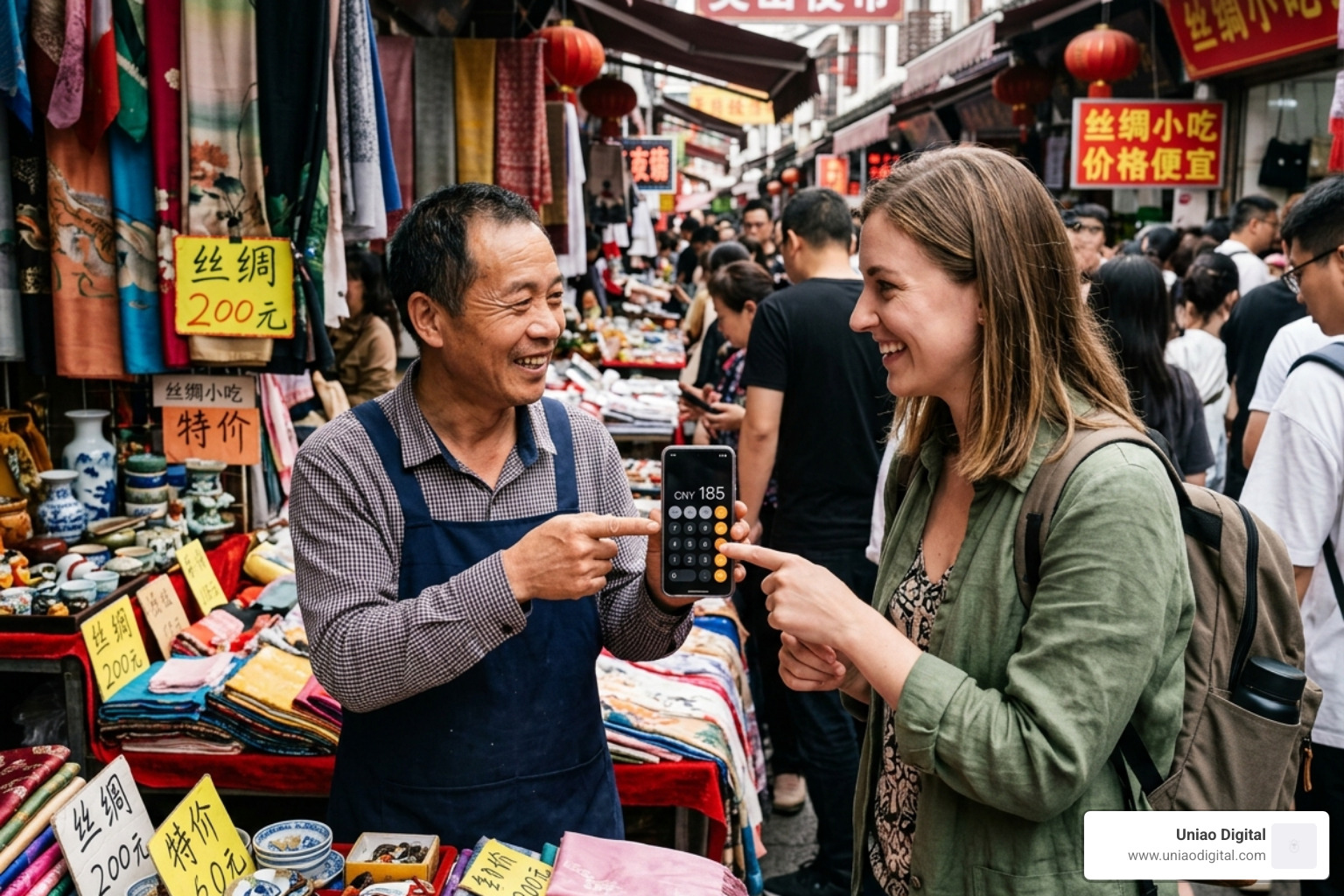
In 2026, technology is your best friend. Most vendors will have a large-button calculator ready.
- The Calculator: If your Mandarin is rusty, use the calculator to type your offer. It avoids any confusion between “four” (sì) and “ten” (shí).
- Silence: After you state your price, stop talking. Let the silence hang. Often, the vendor will lower the price just to break the tension.
- The “Limited Cash” Trick: Pull out a small bill (like a 50 RMB note) and say, “This is all the cash I have left.” Often, they will take it just to close the deal.
Advanced Chinese Market Bargaining Tips for Pro Travelers
Once you’ve mastered the basics, you can use these advanced tactics to save even more.
Leveraging bulk buys and group power
If you are traveling with friends, use your numbers! Buying three of the same jade pendant or five silk fans gives you massive leverage. Ask for a “bundle price.” We often say, “If I buy three, can I get them for the price of two?”
You can also “bundle across stalls” in some smaller markets. If you see two vendors who are neighbors, mention that the other guy offered a better price for a similar item. Competition is a powerful motivator.
Navigating language barriers with Chinese market bargaining tips
While English is spoken in major markets like the Silk Street in Beijing, speaking even a tiny bit of Mandarin changes the dynamic. It shows you aren’t a “clueless tourist.”
At Uniao Digital, we provide AI-powered language tools specifically designed to help you with local slang and travel communication. Using our tools to learn a few “street-smart” phrases can help you break the “rich foreigner” myth and get the local rate. For more on these skills, check out this guide on Shopping and Bargaining in China.
Quality inspection before payment
A common mistake is bargaining hard and then forgetting to check the goods. Before you hand over your money (or scan that QR code):
- Check zippers on bags.
- Look for loose threads on silk.
- Test electronics to ensure they actually turn on.
- Ensure the item the vendor puts in the bag is the same one you inspected!
Essential Phrases for Every Shopper
You don’t need a degree in linguistics, but these six phrases are your bargaining “survival kit.”
- Duo shao qian? (多(duō)少(shǎo)钱(qián)?) — How much?
- Tai gui le! (太(tài)贵(guì)了(le)!) — Too expensive! (Say this with a smile and a look of shock).
- Pianyi yidian ma? (便(pián)宜(yi)一(yì)点(diǎn)吗(ma)?) — Can it be a little cheaper?
- Zui di jia? (最(zuì)低(dī)价(jià)?) — What is your lowest price? (Use this when you’re ready to close).
- Bu yao. (不(bù)要(yào).) — I don’t want it. (Useful for stopping aggressive sellers).
- Cheng jiao! (成(chéng)交(jiāo)!) — Deal! / Agreed!
Frequently Asked Questions about Bargaining in China
Is it ethical for tourists to bargain in 2026?
Absolutely. In the market context, bargaining is not about “taking money” from a local; it is the standard way business is conducted. A vendor will never sell an item at a loss. If they agree to a price, they are making a profit. By not bargaining, you are actually inflating the market for future travelers and locals alike.
How low should my first offer really be?
For most souvenirs in tourist areas, the initial price is at least double the value. We recommend starting at 25% to 30% of the asking price. If they ask for 100 RMB, start at 25 or 30 RMB. You will eventually meet in the middle around 50 or 60 RMB.
What should I do if a vendor gets angry?
Don’t take it personally! In Chinese markets, “anger” is often part of the theatrical performance. If a vendor seems truly upset or aggressive, simply say “Bu yao” (I don’t want it) and walk away. There are hundreds of other stalls selling the exact same thing.
Conclusion
Mastering chinese market bargaining tips is one of the most rewarding parts of traveling through China. It’s more than just saving a few dollars; it’s about engaging with the local culture, practicing your communication skills, and participating in a tradition that has existed for centuries.
Remember to keep it light, keep it friendly, and don’t be afraid to walk away. The “perfect” price is simply the one that makes both you and the seller happy.
Ready to take your travel communication to the next level? Start your journey with Uniao Digital tools and unlock the local secrets of China’s most vibrant markets. Happy shopping!
